
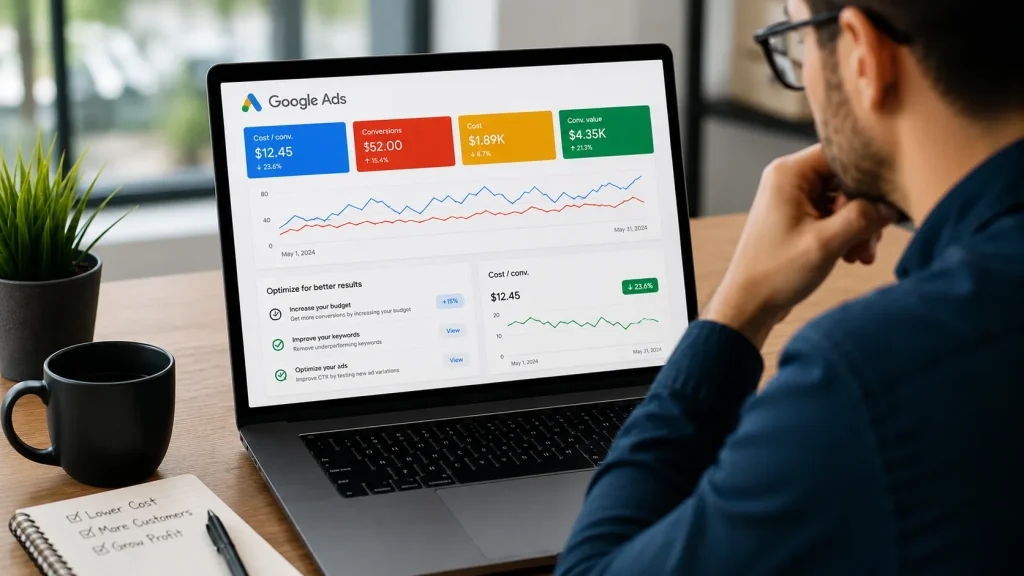
Google Ads remains one of the fastest ways to acquire customers online. However, high advertising costs can quickly reduce profits. According to Google Economic Impact data, businesses typically earn $2 in revenue for every $1 spent on Google Ads. That result depends on campaign quality and optimization. Companies that ignore performance metrics often pay far more per customer than necessary.
Reducing customer acquisition costs requires a combination of better targeting, improved landing pages, and smart bidding. Google reported in 2025 that campaigns using AI-powered bidding strategies achieved stronger conversion performance compared with manual approaches. At the same time, poor keyword selection and weak ad relevance continue to increase costs.
We can lower expenses without sacrificing lead quality. Small improvements in click-through rates and conversion rates create meaningful savings. A campaign with a 5% conversion rate can cut customer costs significantly compared with one converting at 2%.
Understanding how Google Ads works allows businesses to spend efficiently. The goal is not cheaper clicks alone. The objective is acquiring more customers while maintaining healthy returns and sustainable growth.
Improve Keyword Targeting to Lower Costs
Focus on High-Intent Search Terms
Strong keyword targeting directly affects customer acquisition costs. High-intent phrases often generate better conversion rates than broad terms. For example, “buy running shoes online” usually performs better than “running shoes.”
Google Ads Keyword Planner provides estimated search volumes and competition levels. Businesses should prioritize keywords with clear purchase intent. Long-tail keywords typically cost 20% to 50% less than broad keywords while producing higher conversion rates.
Negative keywords are equally important. Excluding irrelevant searches prevents wasted spending. A software company selling premium products may exclude words like “free” or “cheap.” This approach improves campaign efficiency.
Keyword optimization strategies include:
- Use long-tail keywords.
- Add negative keywords regularly.
- Separate branded and non-branded terms.
- Review search term reports weekly.
- Pause underperforming keywords.
These adjustments help businesses reduce unnecessary clicks and attract users with stronger buying intent.
Optimize Ads and Landing Pages
Increase Quality Score
Google Ads rewards relevance through Quality Score. Scores range from 1 to 10. A higher score lowers cost-per-click and improves ad positions. Google estimates advertisers with better Quality Scores can pay significantly less for similar traffic.
Ad relevance depends on three factors:
| Factor | Impact on Performance |
|---|---|
| Expected Click-Through Rate | Higher engagement |
| Ad Relevance | Better keyword matching |
| Landing Page Experience | Improved conversions |
| Page Speed | Lower bounce rates |
| Mobile Optimization | Better user experience |
Fast landing pages matter. Research from Google shows pages loading within 2 seconds generate better conversion rates. Mobile traffic accounted for more than 62% of global web traffic in early 2026. Responsive pages therefore remain essential.
Businesses should maintain message consistency. If an ad promotes a 20% discount, the landing page should immediately display the same offer. This reduces friction and encourages conversions.
Use Smart Bidding and Audience Targeting
Let Automation Improve Efficiency
Google Ads offers automated bidding strategies that adjust bids in real time. Target CPA and Maximize Conversions are popular options. Google’s machine learning analyzes billions of signals during every auction.
Target CPA bidding allows advertisers to specify a desired cost per acquisition. The system then adjusts bids automatically. Many businesses experience stronger efficiency after collecting enough conversion data.
Audience targeting provides additional savings. Remarketing campaigns often produce higher conversion rates because users already know the brand. Customer Match and in-market audiences help reach users with stronger purchase intent.
Effective audience methods include:
- Create remarketing lists.
- Use Customer Match audiences.
- Segment campaigns by demographics.
- Adjust bids for device performance.
- Exclude low-converting audiences.
These practices help improve efficiency without increasing budgets.
Monitor Metrics and Eliminate Waste
Focus on Cost Per Acquisition
Successful campaigns depend on continuous analysis. Cost per acquisition, click-through rate, and conversion rate provide valuable insights. Businesses should review these numbers weekly.
Suppose a company spends $2,000 monthly and acquires 40 customers. The cost per customer equals $50. Increasing conversions to 50 customers lowers acquisition costs to $40. That improvement represents a 20% reduction without increasing spending.
Experts recommend pausing keywords with poor performance after sufficient data accumulates. Budget should shift toward campaigns producing better results.
Important metrics include:
- Cost per acquisition.
- Conversion rate.
- Click-through rate.
- Return on ad spend.
- Quality Score.
- Impression share.
Regular testing also improves outcomes. A/B testing headlines and calls-to-action reveals what resonates with customers. Even a 1% increase in conversion rates can create meaningful savings over time. Get started with our in-depth resource on Voice Search Optimization.
Conclusion
Reducing acquisition costs with Google Ads requires strategic optimization rather than larger budgets. Better keywords, stronger landing pages, automated bidding, and audience targeting all contribute to improved efficiency. Businesses that monitor performance consistently can identify waste and allocate resources more effectively.
Higher Quality Scores and stronger conversion rates lower expenses while increasing customer volume. By focusing on relevant traffic and continuous improvement, companies can build sustainable campaigns that generate more customers at lower costs. Long-term success comes from measuring results, refining strategies, and adapting to changing consumer behavior.